Implants

Implant-supported dentures in Marina del Rey

An implant-supported denture, also called an overdenture, is a removable denture that clips onto two or more dental implants instead of resting on the gums alone. It is for people who have lost all the teeth in a jaw and want a denture that does not slip, especially on the lower arch where conventional dentures struggle most.

At Marina Dentistry the consultation ends with the imaging your case needs and a written plan with a price, before anything is scheduled.

Open six days a week, including Saturday
All PPO plans and several HMO plans accepted
Written estimate before any treatment
Led by Dr. Sameer Aljanedi, DDS

New patient offer

A published offer for this treatment

The same offer as on the specials page, with the fine print on the card. Claim it when you request your visit; we confirm the terms with you before anything is booked.

All new patient specials
On this page
  1. Overview
  2. Who it is for
  3. What to expect
  4. Candidacy and alternatives
  5. Technology
  6. Aftercare
  7. Cost and financing
  8. FAQ
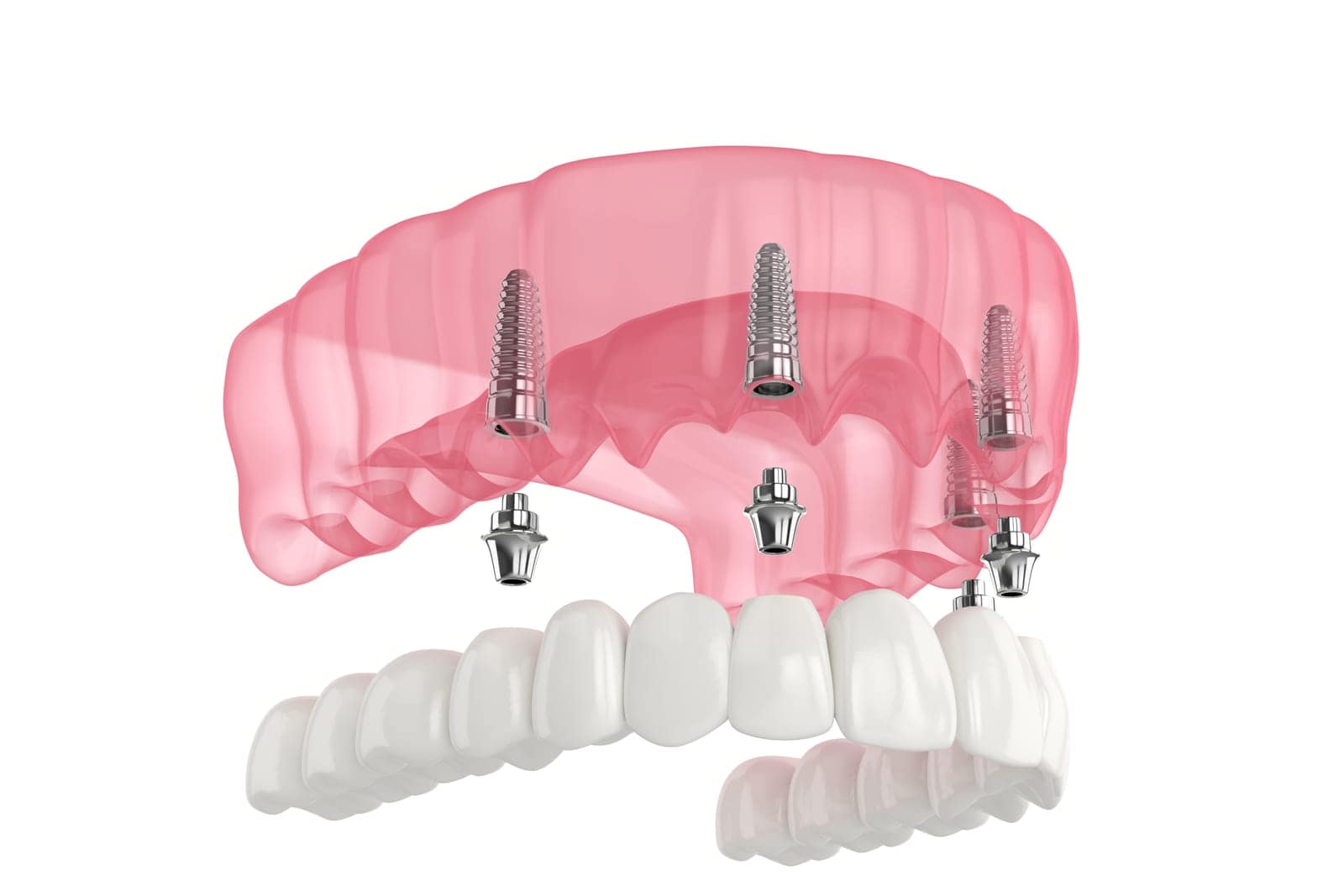
Cutaway model of an upper denture held in place by implants

Quick facts

Good for
A full denture that moves, especially on the lower jaw
Implants
Usually two to four per arch
Timeline
Often three to six months from placement to finished denture
Anesthesia
Local; sedation options available
Removable
Yes, it comes out at night for cleaning

A conventional denture rests on the gums and relies on suction and muscle control to stay in place. On the lower jaw, where there is less surface to grip, dentures slide, rub and trap food. An implant-supported denture solves that by giving the denture something to hold onto.

Two to four implants are placed in the jaw. Once they heal, small attachments are fitted to the implants and matching clips are set into the underside of your denture. You still take it out at night, but during the day it stays where it belongs.

How it compares to a fixed bridge

The other full-arch option is a fixed implant bridge that stays in full time and is removed only by the dentist. It feels the most like natural teeth but uses more implants and costs more. An overdenture uses fewer implants and is simpler to clean. We help you weigh the two.

Who this is for

  • Your lower denture lifts or shifts when you chew or speak
  • You use adhesive daily and still do not trust it
  • Sore spots keep coming back where the denture rubs
  • You have lost all your teeth in one jaw, or are about to
  • You want more stability without the cost of a fixed bridge

If you still have healthy teeth, single implants or a partial denture may be the better fit. The consultation covers all of it.

What to expect, step by step

  1. Consultation and imaging

    Your dentist checks your gums, existing denture and bite, and takes images to see how much bone is available and where implants can go safely.

  2. Implant placement

    Two to four implants are placed under local anesthesia, with sedation if you want it. If you already wear a denture, it is usually adjusted so you can keep wearing it while you heal.

  3. Healing

    The bone fuses to the implants over roughly three to four months. During this time you wear your existing or a temporary denture with a soft liner.

  4. Attachments

    Once the implants are solid, attachments are connected to them and the matching clips are placed in your new or existing denture.

  5. Fitting and adjustment

    You learn to snap the denture in and out, and the fit and bite are adjusted. A follow-up visit a few weeks later catches any sore spots.

Are you a candidate?

Most people who can wear a denture can have an implant-supported one. The lower jaw often has enough bone for two implants even after years of denture wear. The upper jaw is softer and may need four or more implants, or a bone graft or sinus lift, for enough support. Health conditions that slow healing, heavy smoking and certain medications are reviewed before any surgery is planned.

Alternatives worth discussing

  • Conventional complete denture. No surgery and a lower cost. Works reasonably well on the upper jaw for many people. On the lower jaw, movement and bone loss are the recurring problems.
  • Fixed full-arch bridge (All-on-X). Stays in full time on four to six implants. The most natural feel and chewing power, with higher cost and more surgery.
  • Keeping and restoring natural teeth. If some teeth can be saved, crowns, a partial denture or single implants may serve you better than removing everything.

Technology and materials

Implant positions matter more with an overdenture because the clips need to line up. Imaging that shows bone in three dimensions and a guide made from your denture may be used to plan placement.

Recovery and aftercare

Once the attachments are in, daily care is straightforward but non-negotiable.

  • Remove the denture at night and brush it, then brush the attachments and gums with a soft brush
  • Soak the denture as directed and never let it dry out
  • Expect the small inserts in the clips to wear; replacing them is a quick visit
  • Keep regular checkups so the implants and gum health are monitored

Cost and financing

The cost depends on the number of implants, whether your existing denture can be converted or a new one is made, whether grafting is needed and the type of attachment system. You receive a written estimate after your consultation, and our team checks your insurance. We accept all PPO plans and a range of HMO plans; confirm your plan with the office. Payment plans through Cherry, CareCredit and Sunbit are available, subject to credit approval, and our membership plan can help if you are uninsured. See financing and insurance.

What changes the cost

  • Number of implants
  • New denture or converted existing denture
  • Bone grafting if needed
  • Attachment type
  • Upper, lower or both

FAQ

Questions about implant-supported dentures

How much does an implant-supported denture cost?

It depends on how many implants are placed, whether your current denture can be adapted or a new one is made and whether any grafting is needed. We do not publish prices because the range is wide. After your exam you get a written estimate, an insurance check and payment plan options through Cherry, CareCredit and Sunbit.

Does getting implants for a denture hurt?

Implant placement is done under local anesthesia, with sedation available if you are anxious, so the procedure itself should not be painful. Expect soreness and some swelling for a few days afterward, usually managed with over-the-counter medication. Most people describe it as less involved than they expected.

How long does it take to get a snap-in denture?

Plan on three to six months from implant placement to the finished denture, because the implants need time to fuse with the bone before they can hold the clips. You wear your existing or a temporary denture in the meantime. If grafting is needed first, add a few months of healing.

Can my current denture be made into an implant denture?

Often, yes. If your denture fits well and is in good shape, the clips can be set into its underside after the implants heal. If it is worn, cracked or no longer fits your gums, a new denture built around the implants gives a better result. Your dentist assesses yours at the consultation.

How many implants do I need for a snap-in denture?

Two implants is the common minimum for a lower overdenture and gives a big improvement in stability. Four implants spread the load better and are usually recommended for the upper jaw, where bone is softer and the denture is often made without a palate. Your bone and bite determine the final number.

Ready to take the next step?

Request a time online and we will confirm by phone or text during office hours. Same-day visits for dental emergencies.