
Your child's first dental visit: timing, what happens, sealants
Book your child's first dental visit by the first birthday. What happens at that visit, how to prepare a toddler, when fluoride varnish and sealants come in, and family dentist versus pediatric office.
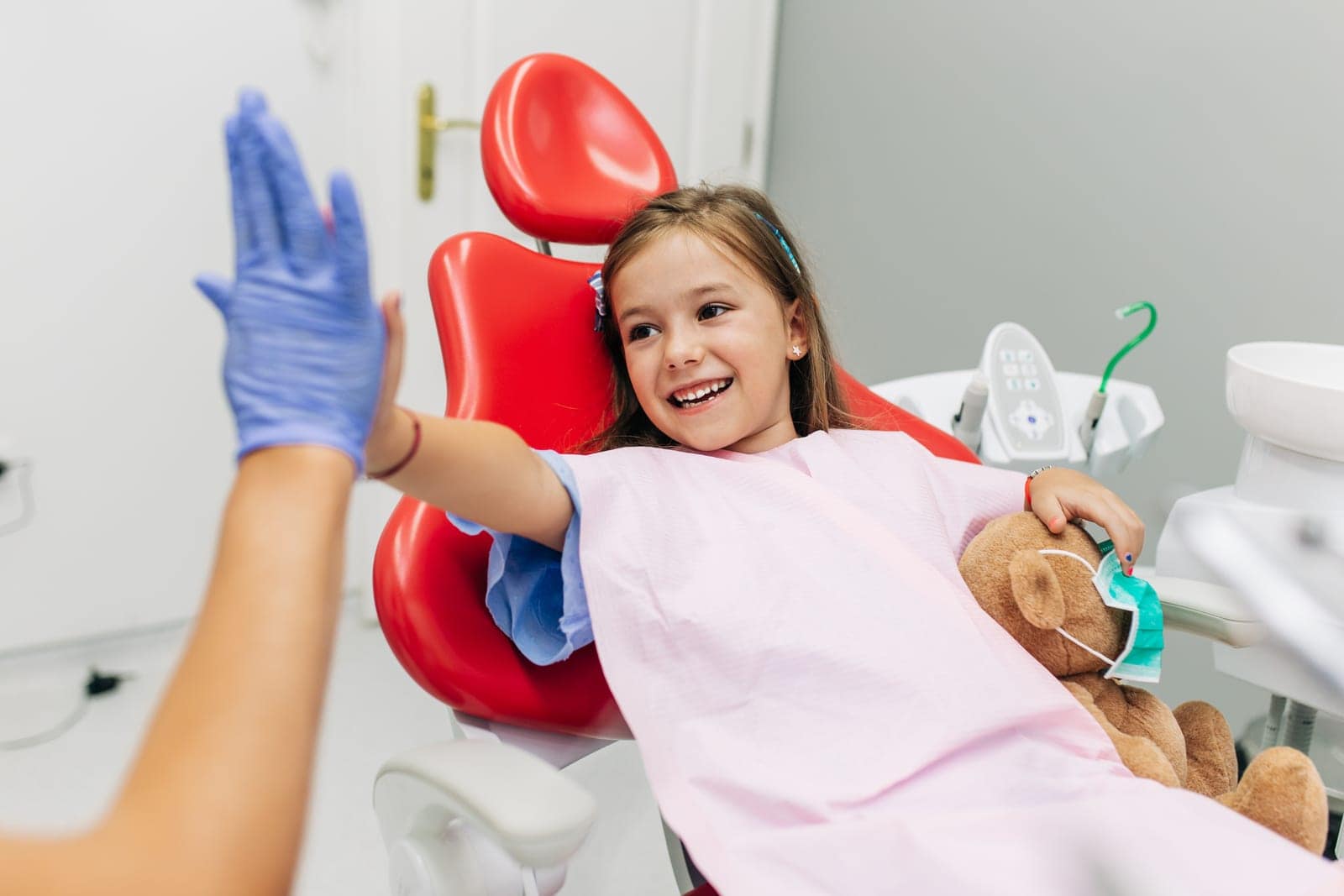
Your child should have a first dental visit by their first birthday, or within six months of the first tooth coming in, whichever comes first. That is the recommendation of both the American Academy of Pediatric Dentistry and the American Dental Association, and the visit is short, gentle and mostly about teaching parents. If your child is older and has never been, the right time to book is now, and the start of the school year is a natural moment to do it.
This post covers what happens at a first visit, how to prepare a toddler, fluoride varnish and sealants, why cavities in baby teeth are treated, when X-rays start, and how to choose between a family dental office and a pediatric one. Marina Dentistry is a family practice, not a pediatric specialty office, and we will be honest about what that means for your child.
Why the first visit comes so early
Age one sounds early for a child with a handful of teeth. The reasoning is that decay in baby teeth can begin as soon as teeth appear, often from milk or juice pooling around the front teeth overnight, and it moves quickly through thin baby enamel. By the time a parent can see a brown spot, the cavity is usually well established.
An early visit catches the earliest changes, when fluoride and a change in habits can still reverse them. Just as important, parents get specific advice: how to clean new teeth, what to do about night bottles and nursing to sleep, when to move off the sippy cup, and which snacks cause the most trouble. The dentist also checks that teeth are arriving in the expected order and that the bite, gums and jaw are developing normally.
The other benefit is less clinical. A child who has visited several times before anything needs fixing treats the office as a familiar place, which makes a first filling, if there ever is one, far easier.
What happens at a first visit
A first visit for a baby or toddler is not a cleaning in the adult sense. It usually goes like this.
The child sits on a parent's lap facing the parent, then lies back into the dentist's lap with their head supported, in what is called a knee-to-knee exam. The dentist sees every tooth in a minute or two while the child can see their parent the whole time.
The dentist counts the teeth, looks at the gums and the inside of the cheeks and lips, checks the bite, and wipes or brushes the teeth to look for early white spots that signal decay beginning. If appropriate, a fluoride varnish is painted on, which takes seconds. Then the dentist talks with you: brushing technique, how much toothpaste, feeding habits, pacifiers and thumbs, and when to come back.
There is no drilling, numbing or X-ray at a typical first visit. Many babies cry during the exam, mostly because a stranger is holding them still, and it stops the moment they sit up.
Preparing a toddler
Children take their cues from the adults around them. A few things help.
- Use neutral words. "The dentist is going to count your teeth and look at your smile." Avoid "hurt," "shot," "drill" and "it won't be bad," which plant the idea that it might be.
- Do not promise a reward for being brave. It frames the visit as something to survive.
- Pick the time of day carefully. Book around naps and meals so your child arrives fed and rested. Early morning or a Saturday morning often works better than late afternoon.
- Practice at home. Let your child count your teeth with a flashlight, then switch. Read a picture book about going to the dentist.
- Bring a comfort object, plus a note of medications, allergies and any concerns.
- Expect imperfection. A first visit where the dentist sees a few teeth and the child leaves cheerful is a success.
Letting a younger child watch a parent or older sibling go first takes the mystery out of it. That is one practical advantage of a family practice, where everyone is seen at one office, often back to back.
Fluoride varnish
Fluoride varnish is a sticky coating painted onto the teeth with a small brush. It sets on contact with saliva and releases fluoride into the enamel over several hours, strengthening it and helping early soft spots harden again. The child can eat and drink soon after, avoiding hot foods and hard brushing until the next morning.
The American Academy of Pediatric Dentistry recommends varnish for children at risk of decay from the time the first tooth appears, applied at regular checkups, more often for children at higher risk. Your dentist will suggest a schedule based on your child's teeth, diet and history. Varnish is safe at the small amount used, and the taste is mild. Many California pediatricians also apply it at well-child visits, so mention it if your child has had it recently.
Sealants: which teeth, when, and how long they last
Sealants are the single most useful preventive step for school-age children, and the start of the school year is a sensible time to think about them.
The chewing surfaces of molars have deep grooves that toothbrush bristles cannot reach the bottom of. Food and bacteria settle there, and that is where most childhood cavities start. A sealant is a thin coating of resin that flows into those grooves and hardens, turning a rough surface into a smooth one that a brush can actually clean.
The teeth that benefit most are the permanent molars. The American Dental Association notes that first permanent molars usually come in around age six and second permanent molars around age twelve, behind the baby teeth rather than replacing any, which is why many parents do not notice them arrive. Each set is ideally sealed soon after it comes fully through the gum.
Applying a sealant takes a few minutes per tooth and needs no numbing: the tooth is cleaned and dried, a mild conditioning gel is applied and rinsed off, the sealant is painted on, and a light hardens it. The child can eat right away. Sealants last for years, are checked at each visit, and can be touched up if a piece chips. The Centers for Disease Control and Prevention reports that sealed molars develop far fewer cavities than unsealed ones, and many dental plans cover sealants on children's permanent molars; confirm your plan with the office.
Why cavities in baby teeth are treated
Parents reasonably ask why a tooth that will fall out needs a filling. Three reasons.
Baby molars are in the mouth for a long time. The American Dental Association's eruption charts show the back baby teeth usually staying in place until around ages ten to twelve, so a cavity in a four-year-old's molar has many years to grow, hurt and infect if left alone.
Baby teeth hold space. Each one keeps the gap open for the adult tooth developing beneath it. A baby tooth lost early to decay lets the neighbors drift, which can crowd the adult tooth out of position later.
Infection spreads. An abscess at the root of a baby tooth sits next to the developing adult tooth and can damage it. It also hurts, disrupts eating and sleep, and is a common reason for missed school.
Treatment depends on the stage. The earliest white spots can often be stopped with fluoride varnish and better brushing. Small cavities get a filling after numbing gel and local anesthetic. Larger cavities in baby molars are often restored with a crown made for baby teeth, because a big filling in a small tooth tends to break.
X-rays for children
There is no fixed age for a first dental X-ray. The American Dental Association and the American Academy of Pediatric Dentistry both advise that X-rays be taken based on the individual child's risk and what the dentist cannot see by eye, not on a calendar. In practice, the first X-rays are usually small bitewings taken once the back baby teeth touch each other, since the surfaces between them are hidden, and once a child can hold still for a few seconds.
Exposure is kept low by taking the fewest images needed and by shielding. If your child has had X-rays elsewhere, ask that office to send them so they are not repeated.
Family dentist or pediatric dentist?
A pediatric dentist completes extra training after dental school focused on children, including very young children, children with special health care needs, and sedation for children. A family or general dentist treats patients of all ages, children included.
For most children with typical needs, a family practice works well: one office for the household, a dentist who already knows the parents, and the chance to watch a sibling go first. Marina Dentistry sees children in that setting, with a general dentist, slow explanations and no pressure to get everything done on the first day. Our children's dentistry page explains what we provide.
Some children are better served at a pediatric office, and we will say so plainly rather than press on: very young children with extensive decay needing several appointments, children with special health care needs that make a standard visit difficult, children who need sedation or general anesthesia to be treated safely, and children whose anxiety has not eased after a few gentle visits. Your dentist will refer you to a pediatric colleague and share the records.
For day-to-day habits once the first visit is behind you, our parents' guide to children's dental care covers brushing, snacks and sports guards.
Fitting it into the school year
September is busy, and a dental visit is easy to push down the list. Book siblings back to back so one trip covers everyone, ask for a Saturday morning if weekday pickup is the obstacle, bring the school's health form if it asks for a dental screening, and if your child plays a fall sport, ask about a mouthguard.
What a child's visit at Marina Dentistry involves
A first visit for a child at Marina Dentistry is short and unhurried. Your dentist examines the teeth and gums, often with your child on your lap, applies fluoride varnish if it is appropriate, and talks with you about brushing, feeding and what to expect next. X-rays are taken only when they add something. If anything needs attention, you leave with a written plan and pricing, and nothing beyond the exam happens that day unless you want it to. The office at 4292 Lincoln Blvd in Marina del Rey is open six days a week, including Saturday from 8 AM to 4 PM. Read our new patient information or book online when you are ready.
This article is general information from Marina Dentistry and not a diagnosis. Only an exam can tell you what is right for your mouth. Request an appointment or call (310) 578-5000.