Snap-in dentures vs fixed full-arch implants: which fits you
Snap-in dentures click onto a few implants and come out at night. Fixed full-arch bridges stay in. Here is how they compare on chewing, cleaning, bone, maintenance and cost tier.
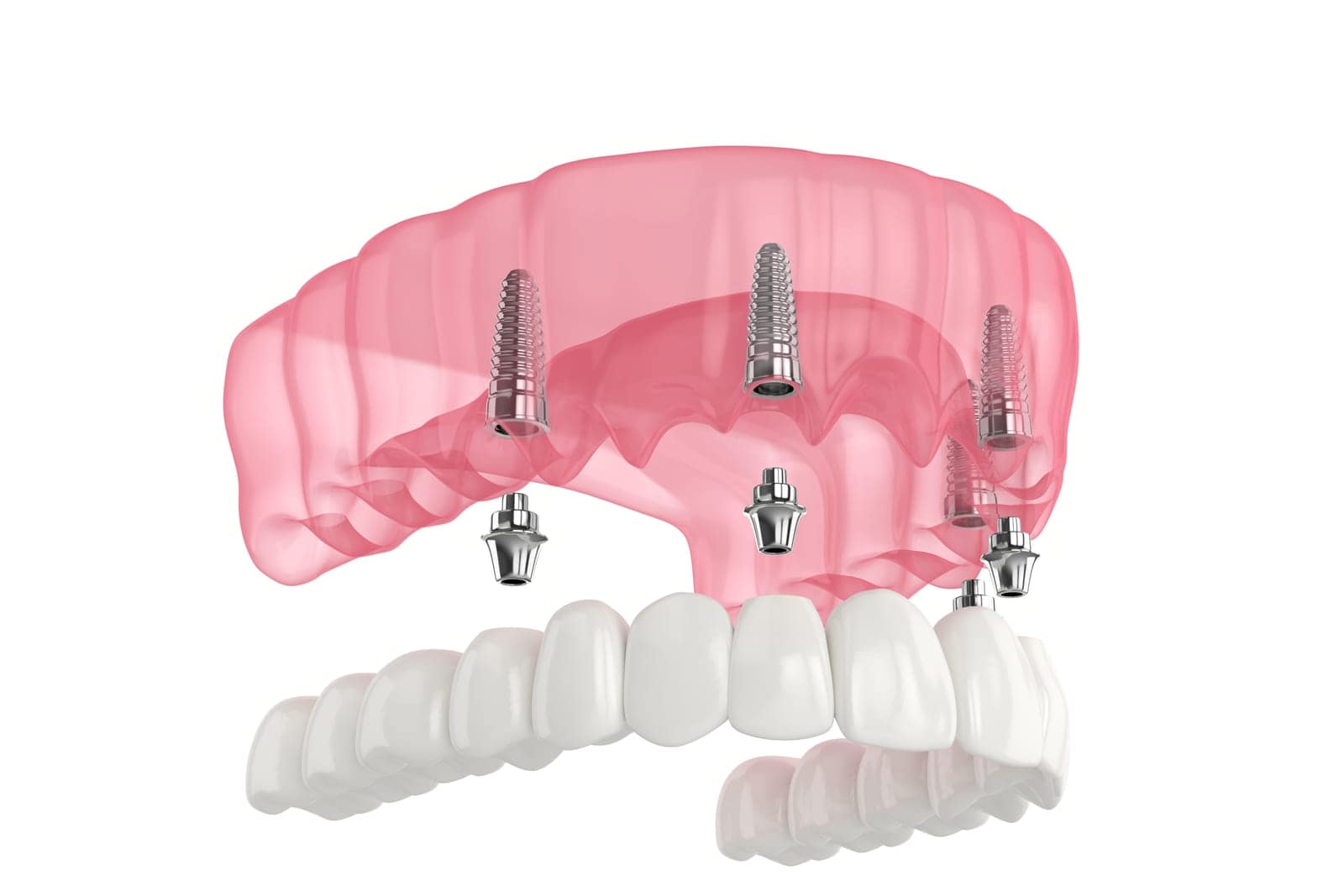
The difference comes down to one word: removable. A snap-in denture, also called an implant overdenture, clicks onto a few implants and comes out every night for cleaning. A fixed full-arch bridge, often called All-on-4 or All-on-X, is screwed onto implants and stays in your mouth; only your dentist removes it. Fixed bridges chew and feel more like natural teeth. Snap-in dentures usually need fewer implants, cost less, and are easier to clean at home. Which fits you depends on your jawbone, your hands, your budget and how you feel about taking teeth out at night.
Marina Dentistry offers implant-supported dentures and All-on-X full-arch implants in the same office, so this comparison does not need to push you toward either.
The three ways to replace a full arch
When most or all of the teeth in an upper or lower jaw are failing or already gone, there are three broad options.
A conventional denture rests on the gums and, in the upper jaw, covers the palate for suction. It is the least expensive option and involves no surgery, but it is also the least stable: it can shift while eating or speaking, often needs adhesive, and does nothing to slow the jawbone shrinkage that follows tooth loss. Our dentures and bridges page covers conventional dentures in detail.
A snap-in overdenture is a denture with attachments on its underside that clip onto implants placed in the jaw. It is still removable and still rests partly on the gums, but the implants hold it in place so it does not float or rock.
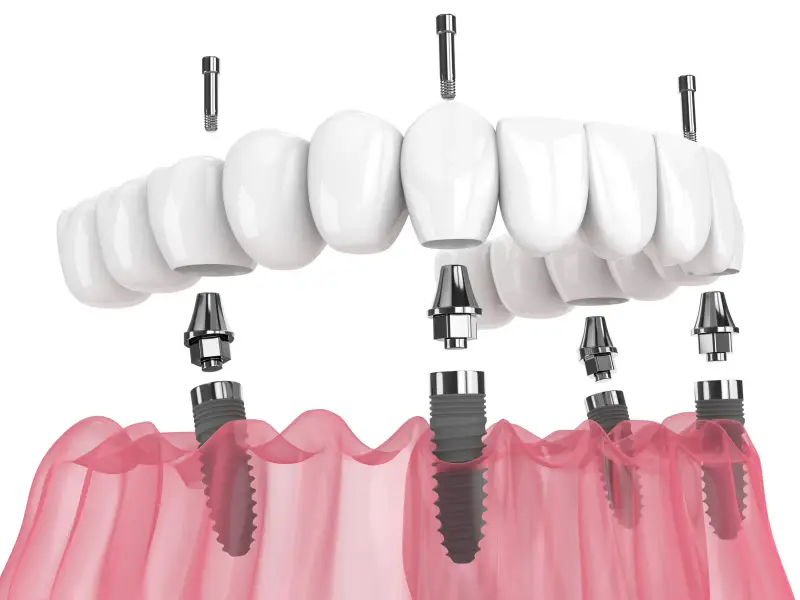
A fixed full-arch bridge is a complete row of teeth attached to implants with screws. It does not rest on the gums, does not cover the palate, and is not taken out by the patient. Our post on All-on-X versus traditional dentures covers that comparison; this one fills in the middle choice.
Snap-in dentures explained
Implants are placed in the jaw and allowed to heal, and each then receives a small attachment. The most common type is a stud-shaped locator with a nylon insert in the denture that snaps over it; the other common design is a thin metal bar connecting the implants, with clips in the denture that grip the bar. Either way, you press the denture down until it clicks and lift it off from the edges.
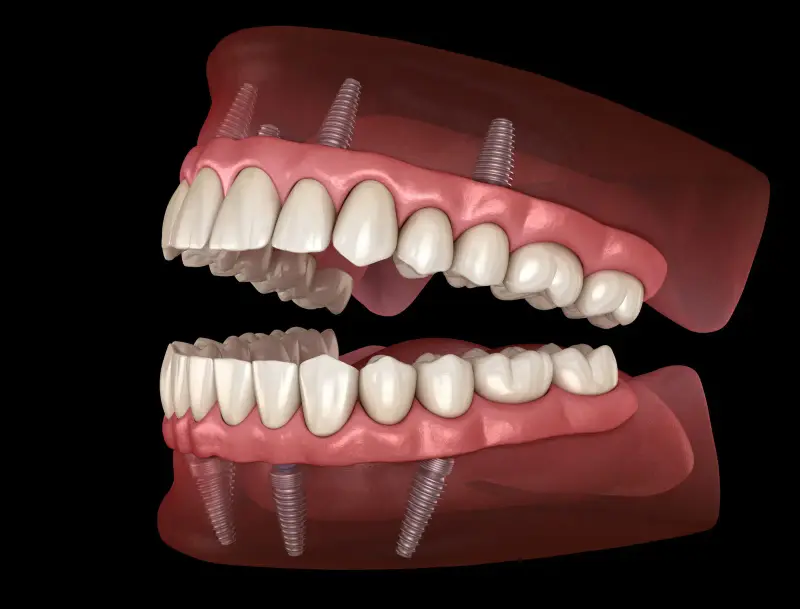
Snap-in dentures rest on a small number of implants: the lower jaw often needs fewer because its bone is denser, while the upper usually needs more and sometimes still covers part of the palate. Your dentist decides the number from your bone volume, your bite and whether palate coverage can be avoided.
Daily life looks like this: the denture comes out at night, you brush it and clean around the implant attachments, and it sits in a case until morning. Dentists advise removing it overnight so the gum underneath can rest and to reduce fungal irritation. Most patients find it far more secure than a conventional denture, with no adhesive and much less movement, though not as rigid as a fixed bridge because it still sits partly on soft tissue.
Fixed full-arch implants (All-on-X) explained
A fixed full-arch bridge uses implants placed at angles chosen to make the most of the available bone, with a bridge of teeth screwed onto them. "All-on-4" refers to the original design; "All-on-X" acknowledges that the number varies with the patient's bone and bite. Depending on the case, a temporary fixed bridge may be attached soon after surgery so you are not without teeth while the implants heal; the final bridge follows once healing is complete.
The bridge does not come out. You brush it like natural teeth, clean underneath it with floss threaders, a water flosser or small interdental brushes, and see your dentist and hygienist on a schedule so the bridge can be removed, cleaned and checked periodically. Because the bridge is anchored to implants and does not rest on the gums, chewing is closer to natural teeth, there is no palate coverage, and nothing moves when you speak or laugh. Our post on full-mouth implants versus dentures over the long term goes deeper on day-to-day life with a fixed bridge.
How they compare, point by point
- Stability. Fixed: rigid, nothing shifts. Snap-in: secure for most eating and speaking, with slight give because it rests partly on the gums.
- Chewing. Fixed: closest to natural teeth; steak, apples and crusty bread are usually fine. Snap-in: a large step up from a conventional denture, though very hard or sticky foods can still be a challenge.
- Speech. Fixed: no palate coverage, so speech usually adapts quickly. Snap-in: lower dentures rarely affect speech; an upper that covers part of the palate takes some getting used to.
- Bulk and palate. Fixed: slim, no palate. Snap-in: more acrylic, and the upper may cover part of the palate depending on how many implants support it.
- Daily cleaning. Fixed: brushing plus cleaning under the bridge, which takes practice and some dexterity. Snap-in: remove, brush, rinse, clean the attachments; simpler for most people.
- Repairs. Fixed: chips and loose screws are handled by the dentist. Snap-in: worn nylon inserts are swapped in a quick visit, and the denture can be relined like any denture.
- Implant count. Fixed: more implants per arch. Snap-in: fewer.
- Surgery and time. Fixed: a longer surgical visit and more involved planning. Snap-in: shorter surgery, sometimes staged.
- Cost tier. Fixed: higher. Snap-in: lower, and sometimes an existing well-fitting denture can be adapted, which lowers it further.
Bone and anatomy: what your jaw allows
Which option is available depends heavily on how much jawbone you have. After teeth are lost, the bone that held them slowly shrinks, and a denture worn for years without implants speeds that up. Implants need enough bone height and width to be stable, and in the upper jaw the sinuses sit just above the back teeth, which limits where implants can go.
Fixed bridges are often planned with implants tilted to reach denser bone at the front of the jaw and avoid the sinuses and the lower-jaw nerve, which is why they can sometimes be done without grafting even when bone is limited. Snap-in dentures also rely on the front of the jaw, where bone survives longest. When there is not enough bone for either, bone grafting or a sinus lift can rebuild it, adding healing time and cost but opening up options. Imaging, which may include a 3D scan, tells your dentist which applies to you; nobody can answer from a glance.
Maintenance over the long run
The honest comparison looks at the next decade, not the first month.
Snap-in dentures. The nylon inserts inside the locator attachments wear down with use and lose their grip; replacing them is a routine, inexpensive visit, but it recurs. The denture rests on gums that keep changing shape, so it needs periodic relining, and like any denture it can eventually need remaking. The implants need the same brushing and professional cleaning that natural teeth do.
Fixed bridges. The acrylic or ceramic teeth can chip, especially in people who grind, and a night guard is often recommended. Screws can loosen and are retightened. Most dentists remove the bridge for a thorough cleaning and inspection on a schedule they set, with routine hygiene visits in between. Over many years the bridge may need to be refurbished or replaced while the implants underneath stay in place.
With either option, the implants themselves are the long-lived part; it is the teeth on top that wear. Gum health around implants matters as much as it does around natural teeth, since inflammation can cost bone and, eventually, an implant. Our post on how long dental implants last covers what protects them.
Who tends to choose snap-in, and who tends to choose fixed
People tend to sort themselves once they understand the trade-offs.
Patients who lean toward snap-in dentures often already wear a denture and are comfortable with the nightly routine; they want it to stop moving, not to change how they live. Some have limited bone and prefer to avoid grafting. Some have arthritis or dexterity limits that make cleaning under a fixed bridge difficult, so a denture they can scrub at the sink is more practical. Budget is a real factor, and a snap-in denture delivers much of the stability benefit at a lower tier.
Patients who lean toward a fixed bridge usually say the same thing: they do not want to take their teeth out. They want to bite into an apple without thinking, dislike acrylic on the palate, and are willing to spend more and learn a new cleaning routine. Good dexterity and a commitment to hygiene visits matter more here.
Neither choice is wrong, and an adult child helping a parent decide should weigh the parent's hands and habits as heavily as the chewing benefit. If you are not sure where you fall, our short dental implant quiz is a useful starting point before a consultation.
Costs and coverage
We do not publish prices for these treatments because they vary with implant number, grafting, the materials used in the final teeth and whether an existing denture can be reused.
Many PPO plans contribute toward the denture or bridge as major restorative work, up to the annual maximum; some contribute toward implants and others exclude them. Coverage varies so widely that the only reliable step is a pre-treatment estimate, which we submit before anything is scheduled so you know what your plan pays; confirm your plan with the office. Because annual maximums reset, some patients split treatment across plan years.
For the balance, payment plans through Cherry, CareCredit and Sunbit are available, subject to credit approval, and our financing and insurance page explains how to apply. If you have no dental insurance, ask whether our membership plan applies to any part of your care; it is not insurance, but it may reduce some fees.
The consultation at Marina Dentistry
A full-arch consultation here is unhurried. Your dentist examines your mouth and any existing denture, takes the imaging needed to see bone volume, nerves and sinuses, which may include a 3D scan, and gathers records such as impressions or photographs. You talk through the comparison above as it applies to your jaw, and you leave with a written plan and pricing for the options that suit you, often both a snap-in and a fixed version, to compare at home. Sedation choices for the surgical visit are discussed at the same time. We are at 4292 Lincoln Blvd in Marina del Rey, open six days a week including Saturday from 8 AM to 4 PM, which makes it easier for a family member to come along. Book online or start with our new patient page.
This article is general information from Marina Dentistry and not a diagnosis. Only an exam can tell you what is right for your mouth. Request an appointment or call (310) 578-5000.